

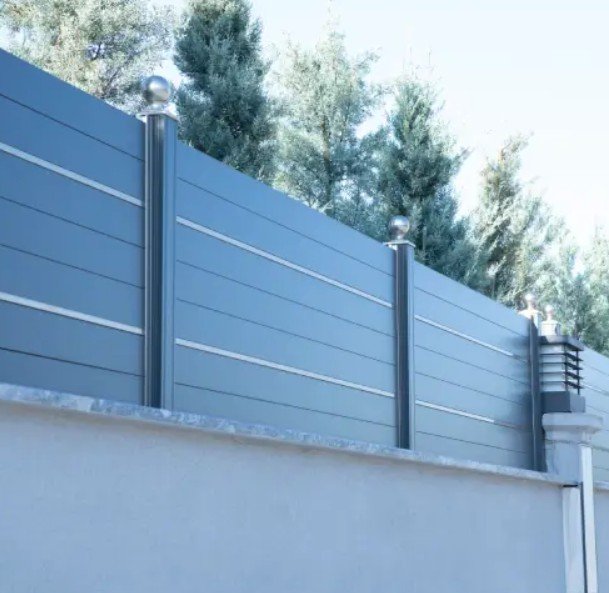
Why backyard fence cost should be measured beyond the first quote
When people search for backyard fence cost, they are usually trying to answer more than one question at the same time. They want to know what the fence will cost to buy, how specification changes affect the final price, and whether a lower upfront figure will still make sense after years of outdoor use. Akos System approaches this topic from a manufacturer’s side and states that backyard aluminum fence cost is typically calculated per linear meter, with final pricing shaped by the model, height, infill type, finish, and order volume rather than by one fixed universal number.
That approach is important because fence pricing only makes sense when it is tied to the actual build-up of the system. Akos explains that its quotations are issued with real specification variables in mind, including privacy slats or glass-panel options, profile thickness, stainless-steel fasteners, and coating standards. In other words, the cost of a backyard fence is not just a material figure. It is the result of structural choices, finish quality, installation logic, and the level of long-term durability built into the product.
Akos System positions cost through manufacturing control
Akos Smart Railings states that it was founded in Konya in 2000 and began manufacturing aluminum railing and glazing systems in 2006. The company says it specializes in aluminum extrusion profiles, balustrade systems, aluminum handrail solutions, aluminum fences, automatic guillotine systems, and automatic garden gates. That wider manufacturing background matters in a pricing discussion because it shows the company is not reselling anonymous fence panels. It is offering a fence category backed by a broader aluminum-systems production capability.
This also affects how cost is structured. On its current backyard fence cost page, Akos presents pricing as factory pricing, with quotations commonly issued on an EXW Konya basis and linked to clearly named models such as Dakota, Arvada, and Leaf. That kind of direct-from-manufacturer logic can be commercially important for distributors, contractors, and project buyers because it gives them a clearer connection between specification and price instead of burying the cost inside multiple reseller layers.
The model you choose has a direct effect on backyard fence cost
One of the clearest reasons backyard fence cost changes from project to project is model selection. Akos’s aluminum privacy fence range includes Dakota, Arvada, Nevada, Florida, Nice, Sun Model, Star Model, Leaf Model, Aludoor Entry, and Aludoor Auto, and the company positions each model with slightly different design language while keeping the same core promises of wind resistance, strength, design variety, and easy installation.
That model variety matters because cost is not only about height and quantity. A simpler linear privacy system and a more decorative pattern-led model do not carry the same fabrication logic. Akos frames Dakota as a durable and aesthetic option, Arvada as a more contemporary and safety-focused design, Nevada as a robust and elegant choice, Florida as a more sophisticated solution, and Leaf as a more decorative direction. For buyers, that means backyard fence cost should be evaluated against the visual and functional result the project actually needs, not as an isolated number.
Height infill and privacy level are major price drivers
Akos states directly that backyard fence cost changes according to height and infill type, which makes sense in practical specification terms. A taller fence requires more material, stronger support logic, and often more demanding installation coordination. The choice between privacy slats and glass-panel infill also changes both material consumption and the technical character of the fence.
This is one of the most important points for a serious buyer. A lower-cost fence on paper may stop being economical if it does not deliver the required privacy level, design consistency, or structural confidence for the site. Akos’s model range gives buyers multiple ways to tune that balance, which is why the company treats pricing as a specification exercise rather than a one-price-fits-all sales pitch.
Material specification is one of the biggest hidden cost factors
A large part of backyard fence cost is determined by what sits behind the surface appearance. Akos states that its aluminum privacy fence panels are manufactured from architectural-grade 6063 aluminum in T5 or T6 temper, with typical slat widths of 90, 120, and 150 mm and wall thicknesses from 1.4 to 2.0 mm. The company also notes that posts are available in 60×60, 80×80, and 100×100 mm sections with 2.0 to 3.0 mm wall thicknesses to suit span and wind-zone requirements.
Those details matter because they explain why not all fence quotations are comparable. Two products may look similar in a photo while being very different in profile thickness, structural reserve, and expected outdoor performance. Akos’s backyard fence cost page also points directly to EN AW-6063-T6 profile thickness as a pricing variable, which confirms that the cost of the fence is closely tied to the actual engineering level of the aluminum system.
Coating and hardware quality influence both price and lifespan
Akos also makes it clear that coating and hardware standards affect cost. The company references stainless steel A2/A4 fasteners and Qualicoat / EN 12206 powder coating as part of the price equation, while its aluminum privacy fence content describes the systems as powder-coated in RAL colors and engineered for long-term outdoor performance.
This is where the idea of value becomes more important than the idea of cheapness. A lower-priced fence that uses lighter hardware or a weaker finish system may cost more later through corrosion, color instability, premature maintenance, or replacement. Akos’s pricing logic suggests that backyard fence cost should be judged in the context of weather resistance, surface durability, and lifecycle performance rather than only by the first line on the quote.
Volume and project scale can change the commercial equation
Akos states that order volume is one of the variables that shapes backyard fence cost, and this is especially relevant for trade buyers or larger residential compounds. The company presents its fence systems as products for trade projects and positions itself around personalized project advice, broad catalog choice, and quotation-based ordering. That structure indicates a pricing model built for real projects rather than for generic single-SKU retail sales.
For buyers, this means cost should be approached strategically. A project with repeated panel dimensions, coordinated finishes, and higher quantities may benefit from a more favorable factory quotation than a fragmented order with multiple unique conditions. In that sense, backyard fence cost is not only a design question. It is also a planning question.
Backyard fence cost also depends on how much customization the project needs
Akos repeatedly highlights personalized advice and a wide range of options in its fence pages, noting that its catalog includes hundreds of different choices and supports project-specific design directions. That is commercially significant because a standard panel run is usually priced differently from a project requiring customized appearances, mixed models, coordinated gates, or more specialized visual detailing.
This is one reason serious buyers should not think about price in isolation from design intent. A backyard fence often needs to work with the entrance gate, the façade palette, the landscape plan, and the required privacy strategy. Akos’s system family makes that kind of coordination possible, but it also means the most accurate price is the one tied to a real project brief rather than to a generic assumed configuration.
Long term value matters as much as the initial fence price
Akos’s Quality Assurance page states that its quality process begins with careful raw-material selection and continues through final delivery, using advanced technology and experienced teams. The company also says every product it delivers is backed by certifications and standards, and that its quality management system is built on continuous improvement and long-term durability.
That matters directly to backyard fence cost because a fence is not judged only on the day it is installed. It is judged after years of wind, rain, sunlight, washing, and daily use. A fence that holds its structure and finish well over time is often the better financial decision even when the initial quote is not the lowest on the market. Akos’s product and quality language clearly leans toward that longer-term view of value.
Certifications strengthen pricing credibility
Akos’s certificates page lists Qualicoat Seaside, Qualanod, ISO 14001, ISO 9001, EN 15088, and several Giordano certificates across related system lines. Even where a certificate is tied to a specific system family rather than directly to the backyard fence cost page, the overall certification structure still strengthens the brand’s position as a serious architectural-systems manufacturer rather than a generic fabricator.
For buyers comparing fence costs, this matters because certification helps explain why one quote may be higher than another. Price differences are often connected to process control, finish quality, compliance discipline, and manufacturing consistency. Akos gives buyers visible reasons to see cost as a reflection of system quality rather than as a disconnected sales number.
A smarter way to evaluate backyard fence cost
The strongest way to evaluate backyard fence cost is to treat it as the result of model choice, height, infill, finish, structural material, hardware grade, order volume, and the quality framework behind the manufacturer. Akos states exactly that on its current pricing page, and its broader fence range supports the same logic through model diversity, architectural-grade aluminum construction, RAL-coated finishes, and project-based quotation.
That makes Akos especially relevant for buyers who are not only asking how much a backyard fence costs, but also what they are truly paying for. In practical terms, the brand is positioned not just around price, but around factory-direct quoting, specification depth, durable material choices, and a product family that can be aligned with both budget and architectural intent.
